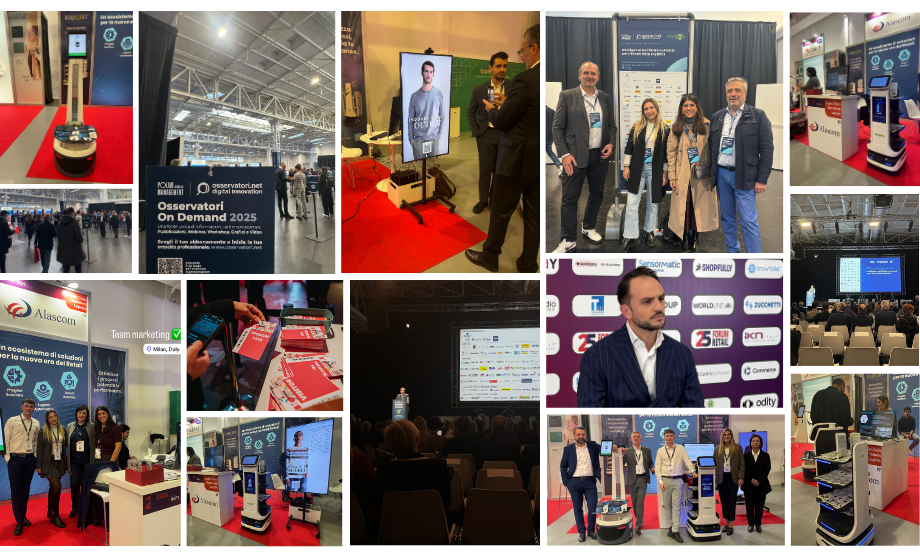
Last week was intense, stimulating, and extremely rich in content for Alascom: three high-profile events that allowed us to engage with professionals, companies, and institutions on themes of innovation, technology, and the future across the tourism, retail, and logistics sectors.
1. BTO 2025 – Florence, 11–12 November
Our first commitment was at BTO – Be Travel Onlife, where we had the pleasure of taking part through our Chief Solutions Architect, Carmine Palladino.
Carmine contributed to the panel titled: “Predictive Housekeeping: the housekeeping department is no longer manual.”
In the hospitality world, operational challenges have become increasingly evident: a shortage of qualified housekeeping staff, rising operating costs, difficulties in maintaining high standards, and the need to respond rapidly to new guest expectations. In this context, robotics (and technological innovation more broadly) is emerging as a strategic ally.
Specifically, robotics can:
• mitigate staff shortages and help reduce turnover;
• optimize operating costs;
• ensure consistent, high-quality cleaning standards;
• enhance the guest experience, making hospitality more efficient and technologically advanced.
The theme of “Cross-Travel”, central to BTO 2025, was the perfect lens to highlight how today’s tourism is no longer just about destinations, but a crossroads of worlds, experiences, innovative tools, and people.
For Alascom, it was an important moment: bringing the voice of innovation applied to hotel housekeeping into a context where technology, robotics, and artificial intelligence blend with hospitality. We remain convinced that this “connected, smart, sustainable” approach is an integral part of the future of hospitality—and beyond.
2. Forum Retail 2025 – Milan, 12–13 November
The second event of the week took us to Forum Retail 2025, celebrating its 25th edition and representing one of the most important meeting points for the retail industry in Italy.
Key themes included technology, data, retail media, and the evolving relationship with the consumer. One of the major takeaways was that today’s customer is increasingly “mobile,” shops across multiple brands, and uses their smartphone even for grocery shopping. As a result, the physical store is changing and must integrate an omnichannel experience.
For this reason, we showcased some of our most innovative solutions. The first step toward more efficient retail begins in the warehouse.
Locus Origin and Locus Vector, the collaborative robots developed by Locus Robotics, represent one of the most advanced innovations in intralogistics. In the retail sector, these technologies are used in warehouses, fulfillment centers, dark stores, and large-format retail locations, where speed and accuracy are essential. The outcome is more agile, efficient, and sustainable logistics—without compromising the human element.
We also presented Mars, part of the Roboost line: a service robot designed to carry out internal delivery tasks and customer interaction. Equipped with a front LED display and digital interfaces, Mars can transform from a simple logistic assistant into an interactive touchpoint—a true in-store communication, promotion, or assistance tool.
Finally, we showcased our phygital solutions, omnichannel strategies that support visibility and engagement across retail stores.
3. Contract Logistics Observatory “Gino Marchet” – Politecnico di Milano, 13 November
Lastly, we took part in the conference organized by the Contract Logistics Observatory “Gino Marchet” of the Politecnico di Milano School of Management, dedicated to the transformations taking place in logistics: “Artificial and human intelligence for the future of logistics.”
Two key points emerged strongly:
• The contract logistics market in Italy is recovering: after a contraction in 2023, revenue for 2025 is expected to reach approximately €112.4 billion (+1.9%).
• Artificial Intelligence, automation, and robotics are becoming strategic pillars for logistics: they require a human-centric approach, not just technical optimization.
In other words: logistics is no longer just “moving goods,” but an ecosystem of relationships, technologies, sustainability, and automation. Here, robotics can make the difference—from the smart warehouse, to automated intralogistics flows, to the data platforms orchestrating it all.
What do we take away from this intense week?
• Innovation is no longer a promise but a necessity—in tourism services, retail, and logistics.
• Across all three macro-sectors (hospitality, retail, logistics), the constants remain the same: qualified personnel, operating costs, quality standards, and speed of response. Here, robotics and automation emerge as crucial levers.
• The approach must always be people & tech: technology does not replace humans; it empowers them, supports them, and frees them for higher-value activities.
• A sustainable vision: beyond efficiency, companies and industries now look to environmental, social, and digital sustainability—being “smart and sustainable” is no longer optional.
At Alascom, we reaffirm our mission to bring these worlds together. Robotics applied to hotel housekeeping, automation in retail and logistics—these are all part of our roadmap. We return from this week with inspiration, networking, real-world cases, and new stimuli to translate into concrete solutions.